
If you are planning IVF, one of the first questions that comes to mind is simple: What age is IVF most successful?
Age is the single most important factor affecting IVF success rates. While modern fertility treatments have improved significantly, the quality and number of eggs decline naturally over time. Understanding how age impacts IVF can help you plan better, reduce stress, and improve your chances of a healthy pregnancy.
This detailed guide explains IVF success rates by age, egg quality, embryo development, miscarriage risk, live birth rates, and what options are available at different stages of life.
Why Age Matters in IVF

IVF success depends mainly on:
- Egg quality
- Ovarian reserve
- Embryo quality
- Uterine health
- Sperm quality
- Overall health and lifestyle
Among these, egg quality declines with age, especially after 35. This affects fertilization, embryo implantation, and miscarriage risk.
Women are born with all the eggs they will ever have. Over time:
- Egg number decreases
- Chromosomal abnormalities increase
- Ovarian response to stimulation reduces
This is why IVF success rates vary significantly by age group.
IVF Success Rates by Age
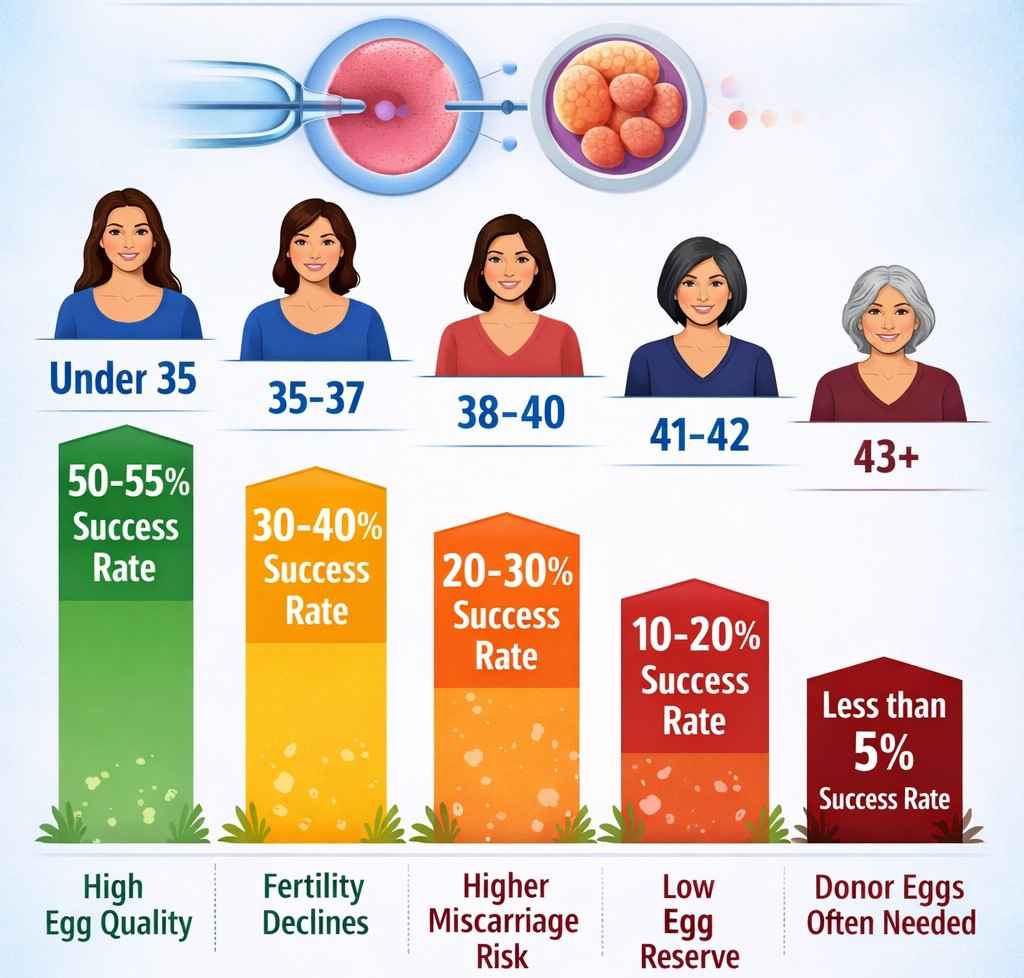
Below is a general overview of IVF live birth rates using a woman’s own eggs. These are global averages and may vary slightly depending on clinic standards and patient health.
Age Under 30
- Live birth rate per cycle: 45% to 55%
- Lowest miscarriage rate
- High embryo quality
- Strong ovarian response
This age group has the highest success because egg quality is at its peak.
Age 30 to 34
- Live birth rate per cycle: 40% to 50%
- Good ovarian reserve
- Strong implantation rates
This is still considered an ideal reproductive age for IVF.
Age 35 to 37
- Live birth rate per cycle: 30% to 40%
- Egg quality begins to decline
- Slight increase in chromosomal issues
Many women in this age group still achieve successful pregnancy with IVF.
Age 38 to 40
- Live birth rate per cycle: 20% to 30%
- Higher miscarriage risk
- Reduced ovarian response
IVF can still work, but sometimes more cycles are needed.
Age 41 to 42
- Live birth rate per cycle: 10% to 20%
- Increased risk of failed implantation
- Higher abnormal embryo rate
Doctors may recommend genetic testing of embryos at this stage.
Age 43 and Above
- Live birth rate per cycle: Less than 5% using own eggs
- High miscarriage risk
- Very low egg quality
In this age group, many couples consider donor eggs for better success rates.
What Is the Most Successful Age for IVF?
The most successful age for IVF is between 25 and 34 years.
During this time:
- Egg quality is strongest
- Embryos are more likely to be chromosomally normal
- Implantation rates are higher
- Miscarriage rates are lower
However, this does not mean IVF cannot work after 35 or 40. Many women have healthy babies with proper evaluation and treatment planning.
IVF Success Is Not Only About Age
Although age is critical, other factors also influence results:
1. Ovarian Reserve
Measured using AMH levels and antral follicle count.
2. Sperm Health
Motility, morphology, and count affect fertilization.
3. Embryo Quality
Day 5 blastocyst transfer improves implantation chances.
4. Lifestyle
Smoking, obesity, alcohol, and stress reduce fertility outcomes.
5. Medical Conditions
PCOS, endometriosis, fibroids, thyroid disorders can impact success.
A personalized fertility evaluation is essential before starting IVF.
How to Improve IVF Success at Any Age
While you cannot change age, you can improve your chances:
- Maintain healthy body weight
- Control blood sugar and thyroid levels
- Avoid smoking and alcohol
- Take prescribed supplements like folic acid
- Consider preimplantation genetic testing if recommended
- Follow stimulation protocols strictly
Choosing an experienced fertility specialist and a medically ethical fertility clinic is important. However, instead of searching only for the best IVF hospital, focus on transparent success rates, qualified doctors, laboratory standards, and individualized treatment planning.
IVF After 35: What You Should Know
Many women delay pregnancy due to career or personal reasons. If you are above 35:
- Do not delay fertility testing
- Check AMH and hormone profile
- Discuss embryo freezing options
- Consider multiple cycle planning
Time becomes more important after 35.
IVF After 40: Is It Possible?
Yes, IVF after 40 is possible, but success rates are lower with own eggs.
Options include:
- Multiple IVF cycles
- Genetic screening of embryos
- Donor egg IVF for higher success
- Lifestyle optimization
Honest counseling and realistic expectations are important at this stage.
Donor Egg IVF and Age
Interestingly, IVF success using donor eggs depends more on the donor’s age than the recipient’s age.
For women above 42 or with very low ovarian reserve, donor egg IVF can significantly increase live birth rates.
Common Questions About IVF and Age
Does IVF guarantee pregnancy at a young age?
No treatment guarantees pregnancy, but younger age improves probability.
Can lifestyle reverse age-related egg decline?
No, but a healthy lifestyle supports better outcomes.
Is 37 too late for IVF?
No. Many women conceive successfully at 37 with proper care.
Should I freeze eggs before 35?
Egg freezing before 35 preserves better quality eggs for future use.
Key Takeaways
- Age is the strongest predictor of IVF success
- Best IVF success rates are seen under 35
- Success gradually declines after 35 and more sharply after 40
- Early fertility evaluation improves outcomes
- Individual factors matter as much as age
If you are planning IVF, do not rely only on age charts. Get a proper fertility workup and make informed decisions based on your specific health condition.
Final Thoughts
Understanding what age is IVF most successful helps you set realistic expectations. Fertility is deeply personal. While statistics provide guidance, your journey will depend on your unique biology, health, and treatment plan.
Early action, proper diagnosis, and evidence-based treatment significantly improve IVF success rates at any age.