
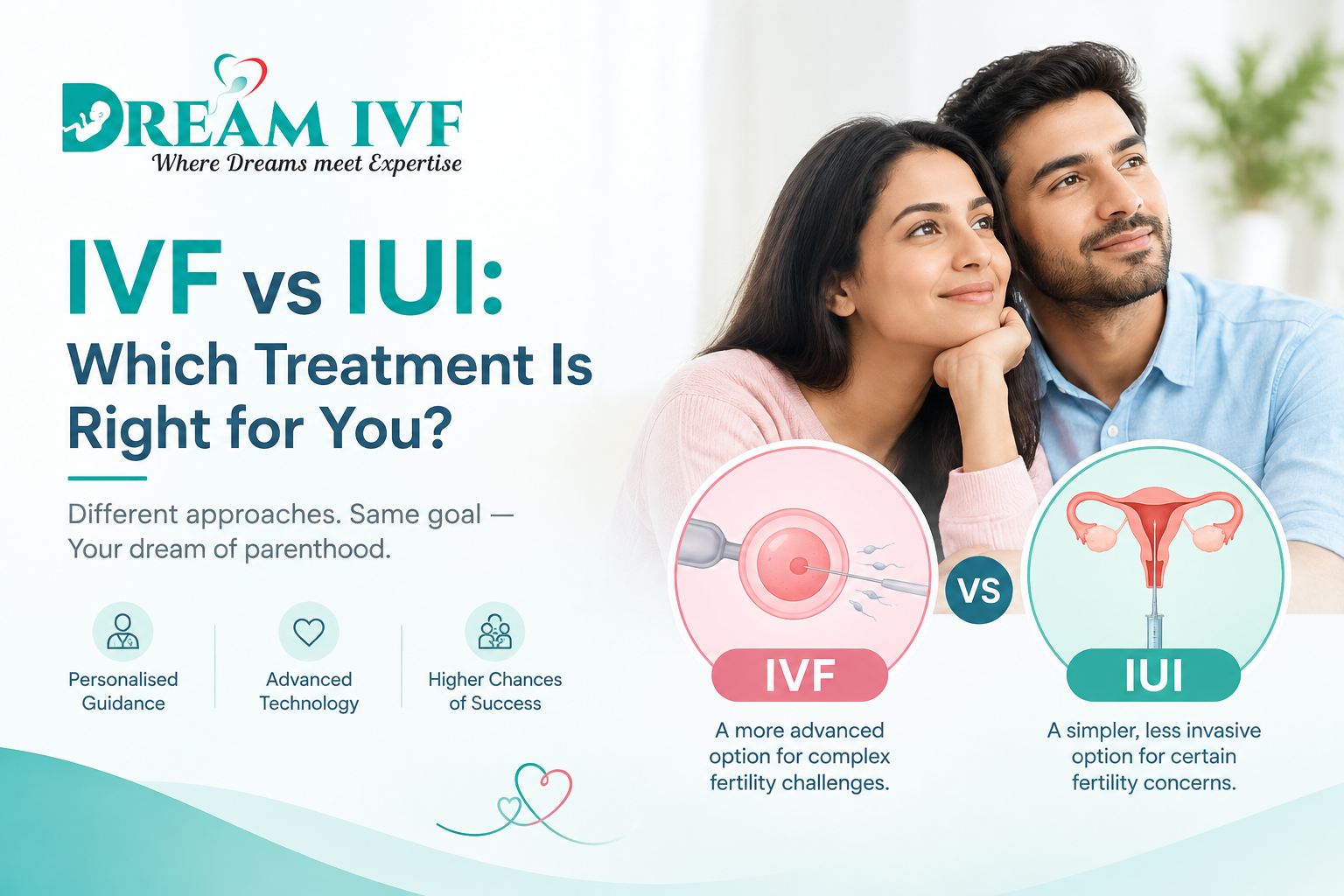
IVF vs IUI: Which Treatment Is Right for You?
Trying to have a baby can be a big step in life. However, getting pregnant does not always happen quickly. When pregnancy does not happen, a fertility doctor can suggest different treatment options.
Two common options are IUI and IVF.
But what is the difference between IVF and IUI? When can IUI help? When may IVF be needed? Most importantly, which treatment is right for you?
The answer depends on your age, health, test results, and the reason for your fertility problem. Therefore, you should not choose a treatment just because it worked for someone else.
In this guide, we explain IVF vs IUI in simple words. You will learn how both treatments work. You will also learn about their differences, cost, success factors, and when a doctor may suggest each one.
At Dream IVF in Patiala, the fertility team offers personal care based on each patient’s needs. The clinic provides fertility tests, IUI, IVF, ICSI, embryo transfer, and other fertility services.
What Is IUI?
IUI means Intrauterine Insemination.
IUI is a simple fertility treatment. During IUI, the doctor puts prepared sperm into the uterus. The doctor does this around the time of ovulation.
The aim is to help the sperm get closer to the egg.
The egg and sperm still meet inside the body. Therefore, IUI does not use a lab to join the egg and sperm.
Also, IUI has fewer steps than IVF. Dream IVF describes IUI as an outpatient treatment. It usually does not need surgery or anaesthesia. The procedure itself takes only a few minutes.
How Does IUI Work?
The IUI process can include these steps:
- First, the doctor checks your monthly cycle.
- Next, the doctor checks when you may release an egg.
- Sometimes, medicines can help the ovaries release an egg.
- The doctor may use an ultrasound scan to check the eggs.
- A sperm sample is collected and cleaned.
- Then, the doctor puts the prepared sperm into the uterus.
- Finally, you may take a pregnancy test about two weeks later.
The exact steps can be different for each person.
IUI may help people with mild sperm problems, some egg release problems, unexplained infertility, or other selected fertility issues.
However, IUI does not suit everyone. A fertility doctor should check both partners before choosing this treatment.
What Is IVF?
IVF means In Vitro Fertilization.
IVF is a fertility treatment that uses a lab to help an egg and sperm join.
First, the doctor gives medicines to help the ovaries grow several eggs. Next, the doctor collects the eggs. The lab team then joins the eggs with sperm.
If an embryo grows, the doctor can place it inside the uterus.
IVF has more steps than IUI. It also needs close checks and lab care.
How Does IVF Work?
An IVF cycle usually has several steps.
1. Medicines to Help the Eggs Grow
First, the doctor gives fertility medicines. These medicines help the ovaries grow eggs.
The doctor then checks the ovaries. Ultrasound scans help the doctor see how the eggs are growing.
2. Egg Collection
When the eggs are ready, the doctor collects them from the ovaries.
Dream IVF states that egg collection is done with anaesthesia at the clinic.
3. Sperm Collection
The male partner usually gives a sperm sample.
In some cases, the medical team may use frozen sperm. They may also collect sperm through another method when needed.
4. Joining the Egg and Sperm
Next, the lab team joins the eggs and sperm.
Sometimes, the doctor may suggest ICSI. ICSI means putting one sperm directly into an egg.
Doctors may use ICSI in some cases of male fertility problems. It may also help when normal fertilization has not worked before.
5. Embryo Growth
After the egg and sperm join, the lab team watches the embryos as they grow.
The team may watch them for a few days. In some cases, an embryo may grow to the blastocyst stage.
6. Embryo Transfer
Next, the doctor puts a suitable embryo into the uterus.
The doctor uses a thin tube for this step.
7. Pregnancy Test
Finally, your doctor will tell you when to take a pregnancy test.
The full IVF plan can be different for each patient. Your doctor will explain each step before treatment.
IVF vs IUI: What Is the Difference?
The main difference between IVF and IUI is where the egg and sperm meet.
With IUI, the doctor puts prepared sperm into the uterus. The egg and sperm then meet inside the body.
With IVF, the doctor collects the eggs. The lab team joins the eggs and sperm in a lab. The doctor then puts an embryo into the uterus.
Here is a simple comparison:
Feature | IUI | IVF |
Full form | Intrauterine Insemination | In Vitro Fertilization |
Where egg and sperm meet | Inside the body | In a lab |
Egg collection | No | Yes |
Lab fertilization | No | Yes |
Embryo transfer | No | Yes |
Number of steps | Fewer | More |
Treatment type | Less involved | More involved |
Cost | Usually lower | Usually higher |
May help with | Some fertility problems | Many fertility problems |
So, IUI vs IVF is not about picking the easiest treatment.
Instead, the goal is to find the treatment that fits your needs.
When May IUI Be a Good Option?
A doctor may suggest IUI when this treatment fits your fertility needs.
For example, IUI may be used for:
- Mild male fertility problems
- Some problems with egg release
- Unexplained infertility
- Some problems with ejaculation
- Some cases of mild endometriosis
- Donor sperm treatment
Dream IVF also lists mild male fertility problems, egg release problems, mild endometriosis, and unexplained infertility among the cases where IUI may be considered.
Also, treatment for unexplained infertility can depend on age and other health factors.
For many couples with unexplained infertility, doctors may try medicines with IUI before moving to IVF.
However, this does not mean that everyone should start with IUI.
Your doctor may suggest another treatment after checking your test results.
When May IVF Be a Good Option?
A doctor may suggest IVF when IUI may not be suitable.
IVF may also be considered when other treatments have not worked.
For example, IVF may be used for:
- Blocked fallopian tubes
- Some cases of endometriosis
- Some male fertility problems
- Some egg release problems
- Previous failed fertility treatment
- Some fertility problems that need IVF
- Some cases of unexplained infertility
The reason for choosing IVF can be different for each person.
At Dream IVF, the fertility team looks at your age, egg supply, past treatment, and fertility history before planning IVF.
IVF vs IUI Success Rate: What Should You Know?
Many people search for IVF vs IUI success rate online.
However, one number cannot tell you your exact chance of pregnancy.
Many things can affect the result of fertility treatment.
These include:
- Age
- Egg quality
- Sperm quality
- Number of eggs
- Reason for infertility
- Fallopian tube health
- Uterus health
- Past treatment
- General reproductive health
Therefore, do not compare your result with another person’s result.
Every fertility journey is different.
Instead, talk to a fertility specialist. The doctor can check your reports and explain the factors that may affect your treatment.
It is also important to know that IVF does not guarantee pregnancy.
IUI vs IVF Cost: Which Treatment Costs More?
Cost is another common question about IUI vs IVF.
In general, IUI costs less than IVF. The main reason is that IUI has fewer steps.
For example, IUI does not need egg collection or lab fertilization.
IVF has more parts. These may include:
- Fertility medicines
- Ultrasound scans
- Egg collection
- Lab fertilization
- Embryo growth
- Embryo transfer
- Other lab work when needed
Therefore, IVF usually costs more than IUI.
However, your final cost can be different.
The total amount may depend on medicines, tests, scans, lab work, and other treatment needs.
So, ask your fertility clinic for a clear cost estimate before starting treatment.
IUI or IVF: Which Treatment Is Right for You?
This is one of the most common questions.
There is no single answer for every couple.
For some people, IUI may be a suitable first step. For others, IVF may be the better treatment option based on their fertility problem.
For example, blocked fallopian tubes can affect IUI because sperm may not reach the egg in the usual way. In such cases, your doctor may discuss IVF.
On the other hand, some couples with unexplained infertility may try IUI first. If pregnancy does not happen after several cycles, the doctor may then discuss IVF.
Your age also matters.
What Tests Are Needed Before IUI or IVF?
Before treatment, your doctor may check both partners.
The fertility check may include:
- Medical history
- Monthly cycle history
- Egg release checks
- Sperm test
- Hormone tests
- Egg supply tests
- Ultrasound scan
- Uterus check
- Fallopian tube tests
The exact tests depend on your health and fertility history.
These tests help the doctor understand why pregnancy may not be happening.
They also help the doctor choose a treatment plan that fits your needs.
Why Is Personal Fertility Care Important?
Every fertility journey is different.
For example, one couple may have a problem with egg release. Another may have a sperm problem. A third couple may have no clear reason for infertility.
Because the problem can be different, the treatment can also be different.
At Dream IVF in Patiala, Dr. Rashmi Vohra provides fertility and reproductive care. She has an MCh in Reproductive Medicine & Surgery and focuses on fertility checks and personal treatment plans.
Dream IVF offers fertility testing, IUI, IVF, ICSI, embryo transfer, and other fertility services.
The clinic is located at Leela Bhawan Chowk, Patiala. You can contact the clinic to discuss your fertility concerns and treatment choices.
IUI vs IVF: A Quick Summary
Still confused about IUI vs IVF?
Here is the simple answer.
IUI
- The doctor prepares the sperm.
- The doctor puts the sperm into the uterus.
- The egg and sperm meet inside the body.
- IUI has fewer steps.
- IUI is less involved than IVF.
- It may help with some fertility problems.
IVF
- The doctor gives medicines to help eggs grow.
- The doctor collects the eggs.
- The lab team joins the eggs and sperm.
- The embryos grow in the lab.
- The doctor puts an embryo into the uterus.
- IVF has more steps than IUI.
In short, IUI helps sperm get closer to the egg inside the body.
IVF uses a lab to join the egg and sperm. The doctor then places an embryo into the uterus.
When Should You See a Fertility Specialist?
You may want to see a fertility specialist if pregnancy has not happened after regular attempts.
In general, fertility checks are often advised after 12 months of trying for women under 35. For women aged 35 or older, doctors often suggest a check after 6 months.
However, you may not need to wait this long.
For example, an earlier check may help if you:
- Have irregular periods
- Know about a fertility problem
- Have had a problem with your reproductive organs
- Have a history that may affect fertility
A fertility specialist can check the possible cause. The doctor can then explain your treatment choices.
Conclusion
IVF and IUI are different fertility treatments.
IUI puts prepared sperm into the uterus. The egg and sperm then meet inside the body.
IVF has more steps. The doctor collects eggs and the lab team joins them with sperm. After that, the doctor puts an embryo into the uterus.
So, the right treatment depends on your fertility needs.
Do not choose IUI or IVF only because someone you know had a good result. Your fertility needs may be very different.
Instead, get a proper fertility check. Then, talk with a qualified fertility specialist about your options.
If you are looking for IUI or IVF treatment in Patiala, Dream IVF provides fertility checks and treatments such as IUI, IVF, and ICSI.
FAQs
1. What is the main difference between IVF and IUI?
IUI puts prepared sperm into the uterus. The egg and sperm then meet inside the body. IVF uses a lab to join the egg and sperm. The doctor later puts an embryo into the uterus.
2. Is IUI easier than IVF?
IUI usually has fewer steps than IVF. It is also less involved. However, your doctor should first check whether IUI is right for you
3. Is IVF more successful than IUI?
The result can be different for each person. Age, egg quality, sperm quality, and the reason for infertility can all affect the result. Therefore, your doctor should review your case before discussing your chances.
4. Is IUI cheaper than IVF?
Usually, yes. IUI has fewer steps. It also does not need egg collection or lab fertilization. However, the final IUI cost can change based on medicines and other tests.
5. How long does IUI take?
The IUI procedure itself is short. Dream IVF states that the procedure usually takes only a few minutes.