IVF can feel like a journey filled with hope, excitement, and, sometimes, a whole new medical vocabulary. One term that can leave couples confused is embryo mosaicism. If you’ve received a mosaic result after embryo testing, you may immediately wonder, “Does this mean the embryo isn’t healthy?” or “Can a mosaic embryo still lead to a healthy pregnancy?” The answer isn’t simply yes or no. Embryo mosaicism is a complex topic, and the result needs to be understood in the context of the specific genetic test, the embryo, and your individual fertility situation. Current reproductive medicine guidance also highlights that mosaic PGT-A results can have several possible explanations and shouldn’t be treated as a straightforward diagnosis of the entire embryo.
What Is Embryo Mosaicism?
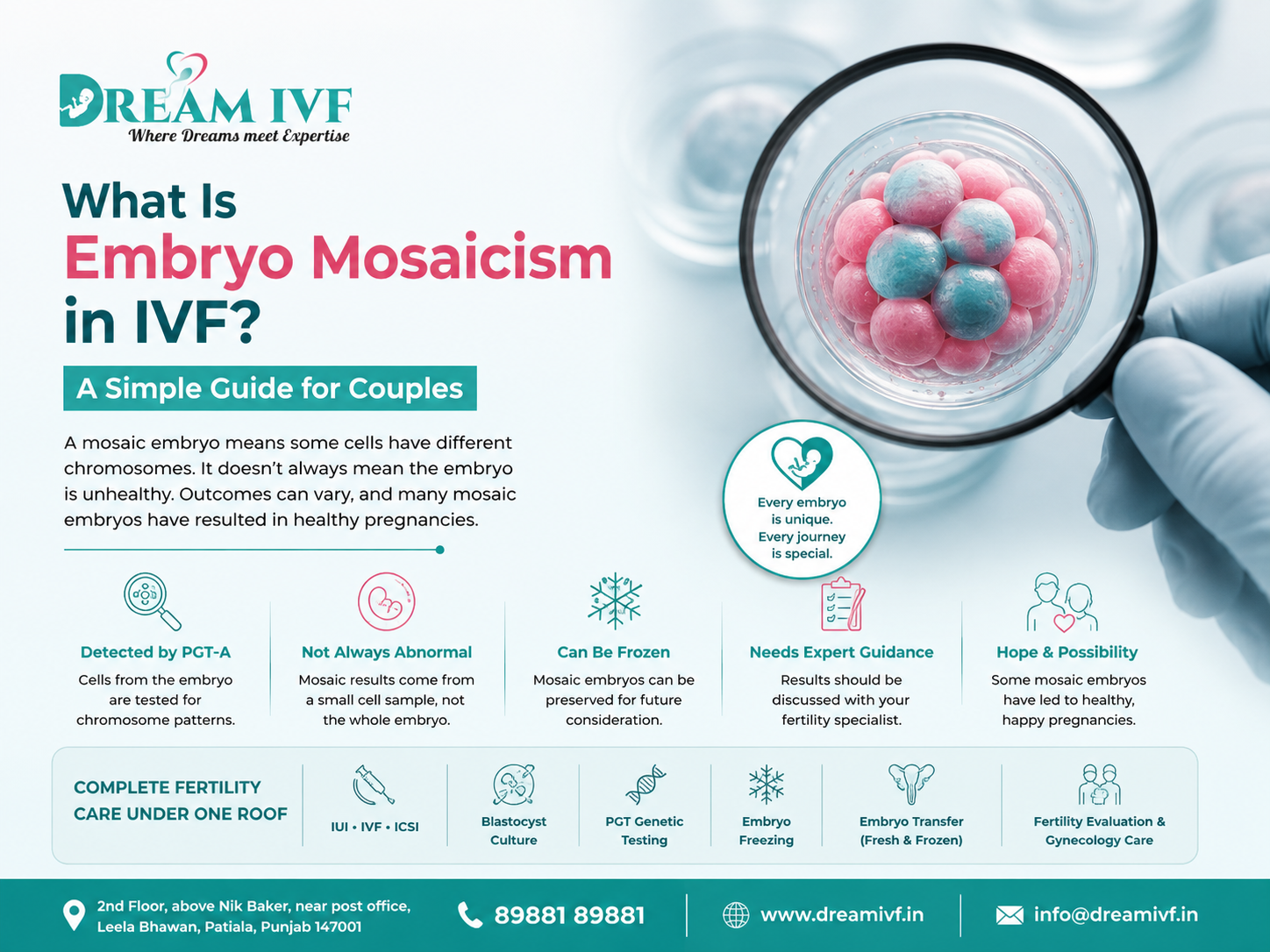
Embryo mosaicism refers to a situation where cells tested from an embryo show different chromosome patterns. In simple terms, some of the cells in the tested sample may appear chromosomally typical, while others may show a chromosome difference. Mosaic results are usually identified through preimplantation genetic testing for aneuploidy (PGT-A) during an IVF cycle. Here’s the important part: the test looks at a small number of cells taken from the embryo’s outer layer. So, a mosaic result doesn’t necessarily tell us that every cell in the embryo has the same genetic pattern. That’s one reason these results can be difficult to interpret.
How Is Mosaicism Detected During IVF?
During IVF, eggs are collected and fertilised in the laboratory. Embryos are then monitored as they develop. Some embryos reach the blastocyst stage, usually around day 5 or 6. At this stage, a small sample of cells from the outer layer may be taken for genetic testing. Dream IVF offers blastocyst culture as part of its fertility services, allowing embryos to be developed to the blastocyst stage before the next treatment decision is made. The clinic also provides genetic testing of embryos (PGT). If the laboratory detects an intermediate chromosome copy-number result, the embryo may be reported as mosaic. However, ASRM notes that factors such as testing variation, amplification bias, contamination, biopsy technique, and laboratory methods can also contribute to an intermediate result. So, “mosaic” doesn’t always mean that true mosaicism has been definitively proven throughout the embryo.
Does a Mosaic Embryo Mean the Embryo Is Unhealthy?
Not automatically. This is probably the biggest question couples have, and understandably so. A mosaic PGT-A result is based on the cells that were tested. It doesn’t provide a complete genetic assessment of every cell that will eventually make up the pregnancy.
Research and professional guidance indicate that some embryos with mosaic results can implant and result in apparently chromosomally typical live births. At the same time, some mosaic results have been associated with lower implantation potential or higher miscarriage rates compared with embryos reported as euploid.
That means a mosaic result should be taken seriously, but it shouldn’t automatically be interpreted as a hopeless outcome.
Can a Mosaic Embryo Be Used for Embryo Transfer?
In selected situations, a mosaic-result embryo may be considered for transfer.
The decision isn’t based on the word “mosaic” alone. The fertility team may consider the specific chromosome involved, the laboratory’s report, the type of mosaic result, other embryos available, and the couple’s reproductive history.
Professional guidance recommends appropriate genetic counselling before transferring a mosaic-result embryo so that couples understand the potential benefits, limitations, and uncertainties.
If embryo transfer is being considered, you can learn more about fresh and frozen embryo transfer and how this stage fits into an IVF treatment plan.
What Is the Difference Between Embryo Grading and Mosaicism?
These two terms are often mixed up, but they’re not the same thing.
Embryo grading looks at the embryo’s appearance and development under laboratory assessment. It may consider characteristics such as the inner cell mass, trophectoderm and degree of expansion.
Mosaicism, on the other hand, relates to genetic findings from the cells tested during PGT.
An embryo may look promising under the microscope but have a genetic finding on testing. Similarly, an embryo with a particular morphological grade shouldn’t be assumed to have a specific genetic status without appropriate testing.
In other words, appearance and genetics are different pieces of the puzzle.
What Happens If a Mosaic Embryo Is Frozen?
Embryos can be preserved through cryopreservation when appropriate.
Dream IVF provides embryo freezing, which allows suitable embryos to be stored for possible future use.
If a mosaic result has been reported, your fertility specialist can explain whether the embryo should be stored and what options may be considered later.
It’s also worth remembering that decisions about freezing or transferring embryos are individual. There isn’t one rule that applies to every couple.
What Should You Do After Receiving a Mosaic Result?
First, don’t jump to conclusions.
A genetic report can contain a lot of information, and the wording can sound intimidating when you’re reading it on your own. Ask your fertility specialist to explain the result in plain language.
You may want to ask:
- Which chromosome is involved?
- What type of mosaic result was reported?
- What level of mosaicism was identified?
- Are there other embryos available?
- What are the potential benefits and limitations of transferring this embryo?
- Should genetic counselling be considered?
- What prenatal testing options may be discussed if pregnancy occurs?
These questions can help you make a decision based on information rather than fear.
Choosing Fertility Care in Patiala
If you’re searching for an IVF center in Patiala, look for a fertility team that can guide you through more than just the IVF procedure itself.
Genetic testing, embryo development, cryopreservation and embryo transfer can all become important parts of fertility care depending on the individual situation.
Dream IVF provides IUI, IVF and ICSI treatment along with fertility evaluation and related reproductive services.
For couples looking for the best IVF centre in Patiala, personalised evaluation matters. Fertility treatment isn’t a one-size-fits-all process. The right approach depends on factors affecting both partners, previous treatment history, reproductive health and the findings from relevant investigations.
Dream IVF also offers evaluation of an infertile couple to help identify possible causes of infertility and guide treatment planning.
And if you’re looking for a gynecologist in Patiala for reproductive or women’s health concerns, gynecology care can also form an important part of the overall fertility journey.
For couples considering an IVF centre in Punjab, the goal should be clear communication, appropriate testing and a treatment plan built around the individual rather than simply choosing treatment because it’s popular.
Understanding Your Mosaic Embryo Result
Embryo mosaicism can sound alarming when you first hear the term. But a mosaic PGT-A result isn’t as simple as calling an embryo “healthy” or “unhealthy.”
The result comes from a limited biopsy sample, and several factors can influence how that result is interpreted. Some mosaic-result embryos have resulted in healthy pregnancies, while certain mosaic findings may carry additional reproductive considerations.
If you’ve received a mosaic result, the best next step is to discuss the report with your fertility specialist and, where appropriate, a qualified genetic counsellor.
Good fertility care isn’t just about getting a test result. It’s about understanding what that result actually means for you.
Frequently Asked Questions About Embryo Mosaicism
1. What does embryo mosaicism mean in IVF?
Embryo mosaicism means that cells from the tested embryo sample show different chromosome patterns. Some cells may appear chromosomally typical while others show a chromosome difference.
2. Is a mosaic embryo abnormal?
Not necessarily. A mosaic PGT-A result comes from a limited sample of cells and doesn’t automatically establish that every cell in the embryo has the same chromosome pattern.
3. Can a mosaic embryo result in a healthy pregnancy?
Yes, mosaic-result embryos have resulted in apparently chromosomally typical live births. However, outcomes can vary depending on the specific result and individual circumstances.
4. Can a mosaic embryo be transferred?
In selected cases, yes. The decision should be made after reviewing the genetic report, available embryos and individual clinical circumstances, often with genetic counselling.
5. What is PGT-A in IVF?
PGT-A is preimplantation genetic testing for aneuploidy. It examines cells from an IVF embryo to look for chromosome-number abnormalities before an embryo transfer is considered.
6. Does mosaicism reduce IVF success?
Some studies have reported lower implantation potential and higher miscarriage rates for certain mosaic-result embryos compared with embryos reported as euploid. However, outcomes vary and the result needs individual interpretation.
7. Is embryo grading the same as genetic testing?
No. Embryo grading assesses development and appearance, while PGT examines genetic material from the cells that were biopsied.
8. Can mosaic embryos be frozen?
Yes. Suitable embryos can be cryopreserved, depending on the treatment plan and clinical circumstances. Dream IVF offers embryo freezing as part of its fertility services.
9. Should every IVF patient have PGT-A?
Not necessarily. Professional guidance notes that the value of PGT-A as a universal screening test for everyone undergoing IVF has not been established. Whether testing is appropriate depends on the individual’s circumstances and should be discussed with a fertility specialist.
10. Where can I get fertility treatment in Patiala?
Couples exploring IVF Patiala options can begin with a fertility consultation and evaluation. Dream IVF provides fertility evaluation, IVF, IUI, ICSI, PGT, blastocyst culture, embryo transfer and cryopreservation services.